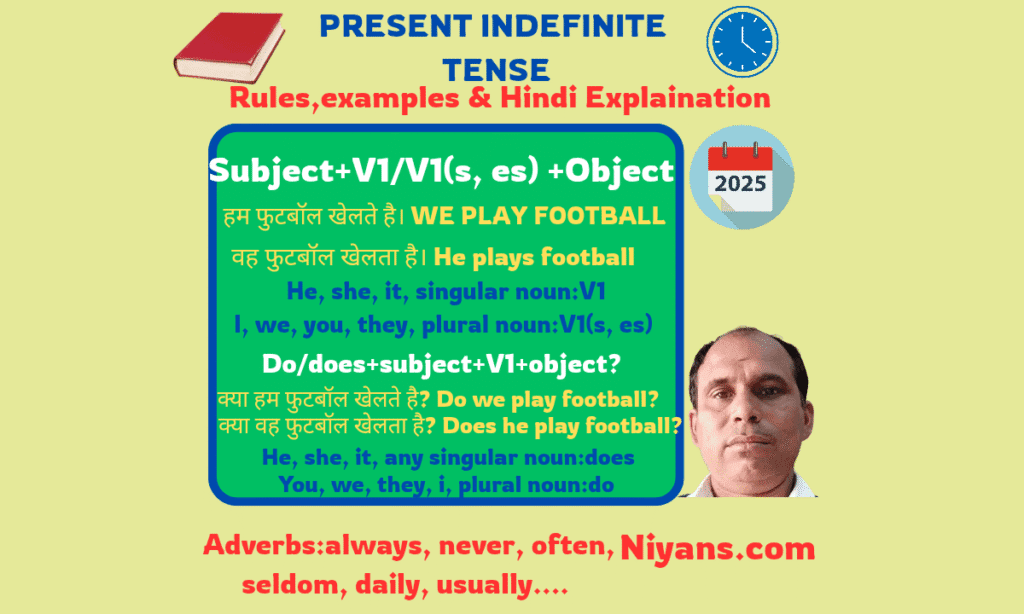
Subject Verb Agreement क्या होता है?
English Grammar में Subject Verb Agreement एक बहुत ही important topic है।
इसमें अक्सर students गलती करते हैं, खासकर:
He go to school. (wrong)
The boys is playing. (wrong)
इन गलतियों से बचने के लिए Subject–Verb Agreement को समझना बहुत ज़रूरी है।यह topic Class 6, 7, 8, 9 और 10 के exams के लिए बहुत important है।
Subject Verb Agreement की Definition
Sentence में Subject (कर्ता) और Verb (क्रिया) का number और person के अनुसार सही होना ही Subject–Verb Agreement कहलाता है।
यानि:
जैसा Subject होगा → वैसी ही Verb आएगी।
Subject और Verb क्या होते हैं?
Subject: जो काम करता है
Verb: जो काम होता है
Ram plays cricket.
(Ram = Subject, plays = Verb)
Subject Verb Agreement Rules
Rule 1: Singular Subject → Singular Verb
He plays cricket.
The boy is honest.
My father works in a bank.
Rule 2: Plural Subject → Plural Verb
They play cricket.
The boys are happy.
My friends live here.
Rule 3: Two subjects joined by and → Plural verb
Ram and Shyam are friends.
A pen and a pencil are on the table.
Rule 4: Two subjects joined by and लेकिन verb singular क्यों?
जब दो nouns and से जुड़े हों, लेकिन वे मिलकर एक ही व्यक्ति, एक ही वस्तु, या एक ही idea को बताएं, तो verb singular आती है।
आमतौर पर:
Ram and Shyam → दो आदमी → verb plural
लेकिन कुछ cases में:
Bread and butter → दो चीज़ें, पर एक ही भोजन → verb singular
पहचान कैसे करें
अगर वाक्य का मतलब:
एक ही व्यक्ति / एक ही चीज़ / एक ही काम / एक ही idea है → verb singular
दो अलग-अलग व्यक्ति / चीज़ें हैं → verb plural
Examples (Singular Verb)
Bread and butter is my breakfast.
(एक ही नाश्ता माना गया है)
The poet and singer is dead.
(एक ही व्यक्ति poet भी है और singer भी)
My friend and guide has helped me.
(एक ही व्यक्ति friend भी है और guide भी)
Slow and steady wins the race.
(एक ही कहावत / idea)
Rice and curry is his daily food.
(एक ही भोजन के रूप में)
Compare these:
The poet and the singer are dead.
(यहाँ the दो बार है → दो अलग-अलग व्यक्ति)
My friend and my guide are here.
(दो अलग लोग)
Very Important Trick
अगर article (a, the, my, his, etc.) सिर्फ पहले noun के पहले लगा हो → अक्सर एक ही व्यक्ति → singular verb
अगर article दोनों के पहले लगा हो → दो अलग-अलग → plural verb
More Examples:
The secretary and treasurer is present. (एक ही व्यक्ति)
The secretary and the treasurer are present. (दो व्यक्ति)
A black and white dog is here. (एक ही कुत्ता)
A black and a white dog are here. (दो कुत्ते)
Rule 5: Each, Every, Everyone, Everybody, Someone, Nobody → Singular verb
ये दिखने में plural लगते हैं, पर grammar में singular होते हैं।
Examples:
Each boy is present.
Every student has a book.
Everyone likes tea.
Somebody has stolen my pen.
Nobody knows the answer.
Rule 6: Collective Noun (team, class, family, jury, crowd, etc.)
Collective Noun क्या होता है?
Collective Noun वह noun होता है जो कई लोगों या चीज़ों के समूह को एक नाम से बताता है।
Examples of Collective Nouns:
team, class, family, jury, crowd, army, committee, staff, police, group, audience, etc.
अगर group को एक unit (एक ही टीम / एक ही समूह) माना जा रहा है → Singular verb
अगर group के members को अलग-अलग माना जा रहा है → Plural verb
अगर पूरा group एक साथ एक काम कर रहा है → verb singular
अगर group के लोग अलग-अलग काम / अलग opinion दिखा रहे हैं → verb plural
Case 1: Group = One unit → Singular verb
The team is winning the match.
(टीम को एक इकाई माना गया है)
The class is very noisy.
(पूरी class एक साथ)
My family is happy.
(पूरे परिवार की बात)
The army is moving forward.
The committee has taken a decision.
Case 2: Members acting separately → Plural verb
The team are fighting among themselves.
(टीम के खिलाड़ी आपस में लड़ रहे हैं)
The class are discussing their own problems.
(हर student अलग-अलग बात कर रहा है)
My family are living in different cities.
(परिवार के लोग अलग-अलग जगह)
The jury are divided in their opinion.
The staff are not satisfied with their salary.
अगर sentence में ये words आएँ:
among themselves, each other, different, divided, their, separately
तो अक्सर verb plural होगी।
Important Note:
कुछ collective nouns हमेशा plural माने जाते हैं:
The police are investigating the case.
The cattle are grazing in the field.
The people are happy.
(Police, cattle, people → singular verb नहीं लगती)
Compare These:
The committee has taken a decision. (एक unit)
The committee are not agreed on this point. (members अलग-अलग)
The audience is silent.
The audience are clapping and shouting.
Collective noun के साथ verb इस बात पर depend करती है कि हम group को एक मान रहे हैं या उसके members को।
Rule 7: बीच में आने वाले words verb को नहीं बदलते
Sentence में subject और verb के बीच अगर कुछ extra words / phrases आ जाएँ, तो भी verb हमेशा main subject के according ही लगेगी, न कि पास वाले noun के अनुसार।
Verb यह देखकर नहीं लगती कि उसके पास कौन-सा noun है,
Verb यह देखकर लगती है कि असली subject (main subject) कौन है।
Subject Verb agreement अक्सर बीच में आने वाले phrases:
- of
- with
- along with
- together with
- as well as
- in addition to
- besides
- like
Examples
(Singular main subject → Singular verb)
The quality of these apples is good.
(Main subject = quality)
The price of these books is very high.
(Main subject = price)
The teacher along with his students is going.
(Main subject = teacher)
The boy with his friends is playing.
(Main subject = boy)
The captain as well as the players is present.
(Main subject = captain)
Examples
(Plural main subject → Plural verb)
The boys of this class are intelligent.
(Main subject = boys)
The students with their teacher are going on a picnic.
(Main subject = students)
The houses in this village are very old.
(Main subject = houses)
The players along with the coach are coming.
(Main subject = players)
Special Case: One of + plural noun
One ही main subject होता है → verb singular
One of the boys is absent.
One of my friends has come.
One of the books is missing.
One of the boys are absent. (गलत)
पहचान कैसे करें?
- पहले verb से सवाल पूछो: Who / What?
- जो answer आए वही real subject है
- Verb उसी के according लगाओ
Verb पास वाले noun से नहीं, main subject से agree करती है।
Rule 8: Money, Time, Distance, Weight जब एक unit की तरह हों
जब money (पैसा), time (समय), distance (दूरी), weight (वज़न), measurement आदि को एक whole / एक unit माना जाए, तो verb singular आती है — चाहे number plural दिखे।
अगर हम किसी मात्रा को एक ही चीज़ मान रहे हैं, तो verb singular होगी।
Examples (Singular Verb)
Money:
Ten rupees is enough.
Fifty rupees is not a big amount.
Five hundred rupees is too much for this.
Time:
Two hours is enough for me.
Ten minutes is not sufficient.
Five years is a long time.
Distance:
Five kilometers is a long distance.
Ten miles is too far.
Weight:
Fifty kilos is a heavy weight.
Ten kilograms is enough.
Measurement / Quantity:
Ten liters is enough for today.
Twenty meters is a big length.
Compare (जब same चीज़ को अलग-अलग माना जाए):
अगर हम उसी चीज़ को अलग-अलग items की तरह देखें, तो verb plural हो जाती है।
Ten rupees are lying on the table.
(यहाँ ten rupees = दस अलग-अलग सिक्के / नोट)
Two hours were divided into four parts.
(यहाँ two hours = parts में बाँटे गए)
Five kilos are packed in separate bags.
(अलग-अलग पैकेट)
अगर sentence में बात हो रही हो:
- price / amount / time taken / total distance / total weight
तो verb लगभग हमेशा singular होगी।
Plural दिखने वाली quantity भी अगर एक unit की तरह use हो → verb singular होगी।
Rule 9: There is / There are
There sentence का real subject नहीं होता।
Verb हमेशा “there” के बाद आने वाले असली subject (real subject) के अनुसार लगती है।
यानि:
- अगर बाद में आने वाला noun singular है → There is
- अगर बाद में आने वाला noun plural है → There are
Verb “there” को देखकर नहीं, बल्कि उसके बाद आने वाली चीज़ को देखकर लगती है।
Singular Noun → There is
There is a book on the table.
There is a cow in the field.
There is a boy in the room.
There is one mistake in this answer.
(क्यों? क्योंकि: a book, a cow, a boy, one mistake = singular)
Plural Noun → There are
There are five books on the table.
There are many students in the class.
There are two cows in the field.
There are some mistakes in this answer.
जब Singular + Plural दोनों हों (Mixed case)
ऐसे cases में verb पहले आने वाले noun के अनुसार लगती है।
There is a cow and two goats in the field.
(पहले = a cow → singular)
There are two goats and a cow in the field.
(पहले = two goats → plural)
There is a pen and some books on the table.
There are some books and a pen on the table.
Rule 10: Uncountable Nouns → Singular Verb
Uncountable noun के साथ हमेशा singular verb आती है, चाहे वह दिखने में ज़्यादा मात्रा या बहुत ज़्यादा लगे।
Uncountable Noun क्या होता है?
जिन चीज़ों को हम गिन नहीं सकते, बल्कि माप या तौल सकते हैं, उन्हें Uncountable Noun कहते हैं।
Common Uncountable Nouns:
milk, water, rice, sugar, salt, wheat, advice, information, furniture, luggage, news, money, work, homework, scenery, poetry, bread, traffic, equipment, stationery
जो चीज़ गिनी नहीं जाती → उसकी verb भी singular आती है।
subject verb agreement Examples (Singular Verb)
Milk is good for health.
Water is necessary for life.
Rice is expensive today.
Sugar is sweet.
Furniture is costly.
The news is true.
Information is useful.
Advice is always helpful.
Luggage is very heavy.
Bread is fresh.
Note:
कुछ words s पर खत्म होते हैं, लेकिन फिर भी uncountable होते हैं और singular verb लेते हैं:
news, physics, mathematics, politics, economics
Physics is an interesting subject.
Mathematics is easy for me.
Politics is a dirty game.
जब इन्हें countable बना दिया जाए:
अगर हम uncountable noun के साथ:
a piece of, a glass of, a bottle of, a bag of, an item of
जैसे words जोड़ दें, तो verb उस measure word के अनुसार आएगी:
A piece of information is useful.
Two pieces of information are useful.
A glass of milk is on the table.
Two glasses of milk are on the table.
Uncountable noun हमेशा singular verb लेता है, चाहे quantity कितनी भी हो।
Rule 11: A number of / The number of
इस rule में students सबसे ज़्यादा confused होते हैं, इसलिए इसे ध्यान से समझिए।
Rule 1: A number of + plural noun → Plural verb
A number of = many / बहुत सारे
इसलिए verb भी plural आएगी।
Examples: A number of students are absent.
A number of boys are playing in the field.
A number of books are missing.
A number of people have come to see the match.
A number of questions are very easy.
A number of students is absent. (गलत)
Rule 2: The number of + plural noun → Singular verb
The number of = संख्या / total
यहाँ subject असल में number (एक संख्या) होता है, इसलिए verb singular आती है।
Examples:
The number of students is increasing.
The number of boys is very small.
The number of books is large.
The number of mistakes is too many.
The number of applicants has increased.
The number of students are increasing. (गलत)
अगर sentence में लिखा हो:
- A number of = many → verb plural
- The number of = total / count → verb singular
Compare These Two:
A number of students are absent. (बहुत सारे छात्र)
The number of students is 50. (कुल संख्या = 50)
Rule 12: Either–or / Neither–nor
जब sentence में two subjects either–or या neither–nor से जुड़े हों, तो verb हमेशा उस subject के अनुसार आती है जो verb के सबसे पास होता है (nearest subject rule).
Verb यह देखकर नहीं लगती कि पहले कौन सा subject है,
Verb यह देखकर लगती है कि verb के पास कौन सा subject है।
Structure:
Either A or B + verb (according to B)
Neither A nor B + verb (according to B)
(B = जो verb के पास है)
Examples
(Nearest subject = plural → plural verb)
Either he or his friends are coming.
(verb के पास = friends → plural)
Neither the teacher nor the students are ready.
(पास = students → plural)
Either the captain or the players are responsible.
Examples
(Nearest subject = singular → singular verb)
Either his friends or he is coming.
(पास = he → singular)
Neither the boys nor the teacher is present.
(पास = teacher → singular)
Either the players or the captain is responsible.
Mixed Person (I / You / He)
Either you or I am wrong.
(पास = I → am)
Neither he nor I am guilty.
(पास = I → am)
Either you or he is to blame.
(पास = he → is)
पहचान कैसे करें?
- Either–or / Neither–nor को देखो
- Verb के just पास वाला subject ढूँढो
- Verb उसी के according लगाओ
Either–or / Neither–nor में verb हमेशा पास वाले subject के अनुसार लगती है।
Subject Verb Agreement – MCQs
(Practice Questions)
नीचे दिए गए प्रश्नों में सही विकल्प चुनिए:
- a) play
b) plays
c) playing
d) played
Q2. The boys ___ in the field.
- a) is
b) was
c) are
d) has
Q3. Each of the students ___ present.
- a) are
b) were
c) is
d) have
Q4. Bread and butter ___ my breakfast.
- a) are
b) were
c) have
d) is
Q5. The poet and the singer ___ dead.
- a) is
b) was
c) are
d) has
Q6. The team ___ winning the match.
- a) are
b) were
c) is
d) have
Q7. The team ___ fighting among themselves.
- a) is
b) was
c) has
d) are
Q8. One of the boys ___ absent
- a) are
b) were
c) is
d) have
Q9. Ten rupees ___ enough for me.
- a) are
b) were
c) have
d) is
Q10. Ten rupees ___ lying on the table.
- a) is
b) was
c) are
d) has
Q11. There ___ five students in the class.
- a) is
b) was
c) has
d) are
Q12. There ___ a cow and two goats in the field.
- a) are
b) were
c) have
d) is
Q13. Milk ___ good for health.
- a) are
b) were
c) is
d) have
Q14. The news ___ true.
- a) are
b) were
c) have
d) is
Q15. A number of students ___ absent.
- a) is
b) was
c) has
d) are
Q16. The number of students ___ increasing
- a) are
b) were
c) have
d) is
Q17. Either he or his friends ___ coming.
- a) is
b) was
c) has
d) are
Q18. Either his friends or he ___ coming.
- a) are
b) were
c) have
d) is
Q19. Neither the boys nor the teacher ___ present.
- a) are
b) were
c) have
d) is
Q20. The quality of these apples ___ good.
- a) are
b) were
c) have
d) is
Q21. The boy with his friends ___ playing.
- a) are
b) were
c) have
d) is
Q22. Two hours ___ enough for this work.
- a) are
b) were
c) have
d) is
Q23. Physics ___ an interesting subject.
- a) are
b) were
c) have
d) is
Q24. Everybody ___ his duty.
- a) know
b) knew
c) knows
d) have
Q25. A black and white dog ___ here.
- a) are
b) were
c) have
d) is
Answer Key
- b) plays
- c) are
- c) is
- d) is
- c) are
- c) is
- d) are
- c) is
- d) is
- c) are
- d) are
- d) is
- c) is
- d) is
- d) are
- d) is
- d) are
- d) is
- d) is
- d) is
- d) is
- d) is
- d) is
- c) knows
- d) is
FAQ Section
Subject–Verb Agreement क्या होता है?
Subject और Verb का number और person के अनुसार सही होना ही Subject–Verb Agreement कहलाता है।
Subject–Verb Agreement क्यों ज़रूरी है?
इससे sentence grammatically correct बनता है और exam में mistakes नहीं होती।
“A number of” और “The number of” में क्या अंतर है?
A number of के साथ plural verb और The number of के साथ singular verb लगती है।
Either–or में verb कैसे लगती है?
Verb हमेशा पास वाले subject के अनुसार लगती है।
आपको Subject–Verb Agreement का कौन-सा rule सबसे ज्यादा confusing लगता है? नीचे comment में जरूर बताइए। आपकी problem पर हम अलग से example के साथ post या reply देंगे।